The Texas Data Center Boom: Balancing Technological Demand and Grid Constraints
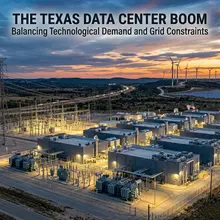
Digital infrastructure underpins modern society. Every search query, streaming video, automated financial transaction, and cloud-stored document relies on physical infrastructure. Data centers operate as the physical factories of the digital age, housing thousands of computer servers, data storage systems, and networking equipment. As digital reliance grows, so does the demand for these massive facilities.
Texas has emerged as a premier destination for data center development. Regions such as Dallas-Fort Worth, Austin, San Antonio, and Houston are experiencing rapid expansion. However, this growth has triggered an intense debate across the state. The controversy centers on the massive electrical and water resource demands of these facilities, raising critical questions about grid stability, environmental sustainability, and the balance of economic benefits.
The Exponential Need for Data Centers
According to reports from the International Energy Agency (IEA), global data center electricity consumption reached approximately 460 terawatt-hours (TWh) in 2022 and could exceed 1,000 TWh by 2026. This escalation stems from several key technological shifts:
- Artificial Intelligence (AI): Training and running large language models requires specialized graphics processing units (GPUs) that consume significantly more power than traditional CPU servers.
- Cloud Computing Migration: Corporations continue to move computational operations from on-premise hardware to centralized, remote cloud facilities.
- The Internet of Things (IoT): Smart devices, automated industrial systems, and connected vehicles generate massive streams of data requiring continuous, real-time processing.
These trends necessitate the construction of high-density computing facilities equipped to handle complex workloads. Major technology companies, including Amazon Web Services, Microsoft, Google, and Meta, alongside specialized colocation developers, are actively searching for locations capable of supporting these immense power and space requirements.
Why Texas Became a Data Center Capital
Market data identifies the Dallas-Fort Worth metroplex as one of the largest data center markets in North America, with other metropolitan areas in the state expanding rapidly. Several factors have driven this concentration of digital infrastructure in Texas:
1. Financial Incentives
Texas Tax Code Section 151.359 provides substantial financial incentives. The statute offers sales and use tax exemptions on electricity and equipment purchased for qualified data centers. To qualify, a facility must meet specific investment thresholds and create a minimum number of permanent, full-time jobs. Over a multi-decade operational lifespan, these exemptions reduce capital and operating costs by tens of millions of dollars.
2. Abundant Land and Lower Construction Costs
The vast geographic footprint of Texas offers flat, affordable land. This availability facilitates the construction of horizontal, single-story facilities. Horizontal layouts are generally easier to cool and secure compared to vertical, multi-story data centers found in denser urban areas.
3. Diverse Energy Generation
Texas features a diverse energy portfolio. The state leads the nation in wind power generation and ranks second in solar capacity, while maintaining a robust baseline of natural gas production. This abundance of energy resources historically promised low-cost power for industrial consumers.
The ERCOT Grid and Energy Consumption Controversy
The rapid expansion of data centers occurs alongside serious concerns regarding the stability of the Texas electrical grid. Unlike other regional grids in the United States, the network managed by the Electric Reliability Council of Texas (ERCOT) operates almost entirely within state borders, possessing minimal connections to neighboring power grids. Consequently, Texas must generate sufficient electricity internally to meet all demand, particularly during extreme weather events.
Memory of the February 2021 winter storm (Winter Storm Uri), which caused catastrophic power outages and numerous fatalities, remains a central driver of utility planning. Subsequent summer heatwaves have repeatedly pushed grid capacity to operational limits, leading to public conservation appeals.
In April 2024, ERCOT Chief Executive Officer Pablo Vegas testified before the Texas Senate Committee on State Affairs. The testimony revealed that projected power demand for the state by 2030 had been revised upward from approximately 110 gigawatts (GW) to nearly 150 GW. According to ERCOT analysis, data centers and cryptocurrency mining operations represent a significant portion of this projected demand growth, alongside general population increases and industrial electrification.
The scale of these power requirements is substantial. A single high-density data center, especially one optimized for AI, can require between 30 and 100 megawatts (MW) of continuous power. Large data center campuses can demand upward of 500 MW to 1 GW. For perspective, one megawatt can power approximately 200 Texas homes during periods of peak summer demand. A single large-scale facility can therefore consume as much electricity as a medium-sized city.
Critics argue that adding gigawatts of continuous, round-the-clock demand threatens grid stability. High-density data centers operate constantly, maintaining a flat energy consumption profile. This continuous load differs from residential consumption, which peaks in the late afternoon and drops overnight. When extreme weather strains generation capacity, the presence of massive, inflexible industrial loads increases the risk of supply shortages.
Environmental and Water Resource Strain
In addition to electricity, resource consumption extends to water usage. High-density computing servers generate substantial heat, requiring continuous cooling to prevent equipment failure. Many data centers employ evaporative cooling systems, which evaporate water to lower the temperature of the air circulated through server rooms. Research published in environmental journals indicates that a typical data center can consume hundreds of thousands to millions of gallons of water daily.
In arid and semi-arid regions of Texas, water scarcity is a persistent challenge. Municipalities in Central and West Texas regularly implement drought restrictions to preserve municipal reservoirs. The allocation of large volumes of water for data center cooling prompts local opposition. Community groups and agricultural representatives express concern that industrial water use competes with agricultural needs and municipal drinking water supplies.
Water consumption models vary significantly based on technology:
- Direct Evaporative Cooling: This method remains popular due to high energy efficiency. Water flows over media while outdoor air passes through, cooling the air before entry into server rooms. This process can consume up to 4 gallons of water per kilowatt-hour of energy consumed.
- Dry Cooling: This system utilizes closed-loop radiator networks, eliminating water evaporation. However, dry cooling operates with lower energy efficiency when ambient temperatures exceed 95 degrees Fahrenheit (35 degrees Celsius). During hot Texas summers, dry-cooled facilities require significantly more electricity to achieve the same cooling effect.
Economic Contributions Versus Ratepayer Costs
The economic impact of data centers remains a subject of intense debate among economists, policymakers, and local communities.
The Proponents' Perspective
Advocates emphasize the economic benefits generated during the design and construction phases. Building a large data center requires hundreds of skilled trade workers, including electricians, concrete contractors, and engineers. Additionally, these facilities contribute significantly to local property tax bases. The high valuation of server equipment and real estate generates substantial tax revenue for school districts, county governments, and municipal services, sometimes lowering the tax burden on residential property owners in specific jurisdictions.
The Critics' Perspective
Conversely, analysts point out that operational data centers employ relatively few permanent staff. A facility costing hundreds of millions of dollars may require only 30 to 50 full-time employees—such as security personnel, facility managers, and systems administrators—once construction concludes.
Furthermore, questions arise regarding the distribution of grid upgrade costs. To connect large data centers, transmission and distribution utilities must construct new substations and high-voltage transmission lines. Under current regulatory frameworks, the capital costs of transmission system upgrades are often socialized, meaning the costs are distributed across all utility customers. This structure leads to potential increases in monthly electricity bills for residential and small business ratepayers. The Office of Public Utility Counsel (OPUC), representing residential consumers in utility proceedings, monitors these rate cases to prevent disproportionate cost shifts.
A Comparative View: Northern Virginia vs. Texas
To understand the scale of the Texas data center boom, a comparison with Northern Virginia provides valuable context. Northern Virginia represents the largest data center market in the world, often referred to as "Data Center Alley." In Virginia, issues such as land availability, transmission line congestion, and aesthetic concerns have created local friction.
Texas presents a different set of challenges. While Northern Virginia experiences transmission constraints within a highly interconnected regional grid (the PJM Interconnection), Texas operates within the isolated ERCOT system. Consequently, grid capacity concerns in Texas carry different operational implications. In Virginia, utility providers can import power from neighboring states during shortages. In Texas, ERCOT must balance supply and demand in real time without the ability to import massive amounts of power from outside state lines during emergencies.
This comparative dynamic underscores why the Texas regulatory environment has historically attracted developers. The state allowed rapid development without the same level of regional grid oversight found in other parts of the country. However, the closing gap between power generation capacity and industrial demand has accelerated the need for policy review in both markets.
Legislative Scrutiny and Regulatory Proposals
The intersection of grid reliability, resource consumption, and economic development has drawn intense scrutiny from Texas legislators. State leadership, including Lieutenant Governor Dan Patrick, has expressed reservation about the unrestricted growth of data centers and cryptocurrency operations. In public statements and during legislative hearings, concerns have been voiced regarding the balance between the energy consumed by data center facilities and the tangible economic value delivered to the state.
Legislative committees are examining potential policy changes ahead of future legislative sessions. Proposed measures include:
- Incentive Modification: Adjusting tax exemption criteria under Section 151.359 to require higher ratios of permanent job creation per megawatt of power consumed.
- Mandatory Demand-Response: Requiring data centers to participate in demand-response programs, meaning the facilities must curtail power usage during grid emergencies.
- Grid Connection Fees: Imposing fees that shift the cost of transmission upgrades entirely onto the industrial developer rather than the general public.
- On-Site Generation Mandates: Encouraging or requiring data centers to construct dedicated, on-site power generation sources, such as natural gas turbines or battery storage arrays, to offset peak demands.
Industry advocacy groups, such as the TechNet coalition and the Data Center Coalition, caution that overly restrictive regulations could deter technological investment, causing companies to relocate planned facilities to states with more favorable regulatory environments. Industry groups argue that data centers facilitate the broader digital economy, supporting remote work, financial services, healthcare technology, and educational platforms utilized by Texas residents daily.
Renewable Energy and Corporate Sustainability Mandates
Many technology companies operating data centers have committed to ambitious carbon-neutrality goals. To meet these targets, corporations enter into virtual power purchase agreements (VPPAs) with wind and solar energy developers in Texas. This relationship has catalyzed the transition to clean energy in the state, funding billions of dollars in renewable energy infrastructure.
However, this arrangement also generates debate. Opponents argue that virtual contracts do not guarantee that clean energy is consumed by the data center in real time. Because wind and solar generation are intermittent, data centers must rely on grid-supplied power—which includes natural gas and coal generation—during periods of low wind or cloud cover. This intermittency means that while the net annual energy balance may be neutral on paper, the physical grid must still support the continuous, unyielding demand of data centers using fossil-fuel resources when renewable generation falls short.
Technological Solutions and Mitigation Strategies
To address grid and environmental concerns, the data center industry is exploring various technological mitigations:
1. Behind-the-Meter Deployment
One strategy involves co-locating data centers directly with power generation assets. By connecting directly to a power plant—such as a solar farm, wind farm, or natural gas facility—the data center reduces reliance on the public transmission grid.
2. Advanced Cooling Technologies
Interest is growing in liquid-to-chip cooling. This technology circulates specialized non-conductive fluids directly over the hottest server components, offering greater thermal transfer efficiency than air cooling. Liquid cooling can significantly reduce both electricity and water consumption in high-density AI clusters.
3. Battery Energy Storage Systems (BESS)
Multiple operators are investing in large-scale on-site battery arrays. These batteries can charge during periods of low grid demand and discharge during peak periods, reducing the strain on the ERCOT grid.
4. Small Modular Reactors (SMRs)
Partnerships with advanced nuclear energy developers represent a long-term option. Small modular reactors could provide continuous, carbon-free power dedicated entirely to data center campuses, isolating the computing infrastructure from the public grid.
Conclusion
The controversy surrounding data centers in Texas highlights the tension between technological advancement and resource constraints. The demand for digital services and artificial intelligence capacity shows no signs of slowing, ensuring that the need for computational infrastructure will persist. Texas remains at the center of this expansion due to historical regulatory advantages, available land, and tax incentives. However, the realities of grid reliability, water scarcity, and public infrastructure costs have prompted a reevaluation of how data center developments are managed. The path forward will likely involve a combination of regulatory adjustments, technological innovation, and infrastructure investment to balance the requirements of the digital economy with the physical limits of the state's power and water resources.
Sources
For further reading and verification of the facts presented, refer to the following sources:
- International Energy Agency (IEA): Electricity 2024 - Analysis and Forecast to 2026.
- Electric Reliability Council of Texas (ERCOT): Legislative Testimony and Power Demand Projections (April 2024).
- Texas Legislature Online: Texas Tax Code Section 151.359 (Sales and Use Tax Exemptions for Data Centers).
- McKinsey & Company: Growing Power Demand from Data Centers (January 2023).
- Texas Senate Committee on State Affairs: Hearing Archives and Testimony on Grid Reliability.
- Office of Public Utility Counsel (OPUC): Consumer Advocacy and Rate Case Documentation.