A Black Eye for the Car Community
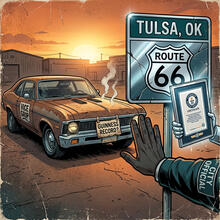
How Tulsa Chased a Trophy and Left Vice Grip Garage and Everyday Gearheads in the Dust
The advertisements promised a historic, once-in-a-lifetime celebration of the open road. It was billed as the Route 66 Capital Cruise on May 30, 2026—a monumental, official Guinness World Record attempt for the largest classic car parade ever assembled. To ensure the grassroots car community knew this was their event, organizers pulled out the ultimate badge of authenticity: they brought in Derek Bieri, the mastermind behind the massive Vice Grip Garage YouTube channel, to serve as a Grand Marshal.
Derek is the undisputed champion of the everyday gearhead. His channel has built an audience of millions on a simple, deeply American premise: saving neglected, rusted iron, fixing it on the ground with basic tools, and driving it home on a wing and a prayer. He doesn't represent the elite, million-dollar concours crowd; he represents the guy who spent six months thrashing in a cold garage to get a family heirloom running. When Derek attached his name and the Vice Grip Garage brand to the Tulsa event, he gave it his personal stamp of approval. Thousands of his fans believed in that endorsement. They bought tickets, booked expensive hotel rooms, filled their tanks, and hauled their prized vintage steel from every corner of the country to Tulsa, Oklahoma.
The car community held up its end of the bargain. More than 5,000 classic cars registered. But when the rubber met the road on that hot Saturday morning, the City of Tulsa, Visit Tulsa, and the event planners utterly failed to handle theirs. Obsessed with securing a PR trophy and a line in a record book, city organizers choked the life out of their own event with staggering logistical incompetence.
They created a massive, miles-long gridlock that left 1,500 credentialed, paying motorists stranded outside the gates, burning through fuel and overheating their engines in stationary traffic. Then, to protect their precious Guinness record, the city slammed the staging gates shut at 11:07 a.m., turning away a massive wave of registered drivers who had been waiting in line for over three hours.
Tulsa got its record. The city officials got their photo-op holding a framed Guinness certificate. But in doing so, they left Derek Bieri hanging, broke their promise to the car community, and gave the grassroots automotive culture what Derek himself called a devastating "black eye."
The Ultimate Grassroots Endorsement
To understand why this failure cuts so deep, you have to understand what Derek Bieri and Vice Grip Garage represent. The automotive world is full of high-end shows where pristine, trailer-queen classics sit behind velvet ropes. Vice Grip Garage is the exact opposite. It’s about dirt, sweat, budget-friendly ingenuity, and a relentless passion for keeping old cars on the road. When Derek tells his audience, "A guy’s gonna try to do a thing," it’s an invitation to be part of a real, welcoming community.
When the Tulsa Route 66 Commission and Tulsa Regional Tourism announced Derek as a Grand Marshal alongside local dignitaries, it wasn't just a marketing gimmick—it was an invocation of trust. Fans knew that if Derek was leading the charge, this wasn't going to be a stiff, corporate parade. It was going to be a celebration of the exact kind of high-mileage, budget-built, soul-filled cars that define the spirit of Route 66.
Driven by that trust, the response was unprecedented. Over 5,000 drivers signed up, many preparing vehicles that had been sitting in barns for years specifically for this cruise. Families packed into station wagons; father-and-son teams spent late nights replacing water pumps and bleeding brakes. They hit the highway toward Oklahoma, expecting a smooth, expertly managed celebration of the Mother Road’s upcoming centennial. Instead, they drove directly into a logistical meat grinder.
The Gridlock of Incompetence
The plan seemed simple enough on paper: thousands of classic vehicles were instructed to arrive at the Expo Square fairgrounds staging area between 6:00 a.m. and 9:00 a.m. on Saturday. But executing an event of this scale requires rigorous infrastructure planning—specifically, professional traffic control, multiple entry points, and an army of coordinated personnel. Tulsa provided none of the above.
Instead of distributing the massive influx of vehicles across multiple gates, the city funneled thousands of volatile, vintage, carbureted machines down 21st Street into what quickly became a catastrophic bottleneck. Witnesses and participants reported a staggering lack of direction. There were virtually no police officers or traffic coordinators directing the flow of cars into the fairgrounds. A single lane of traffic was left to trickle into the staging area while a two-mile-long tailback of irreplaceable classic machinery baked on the asphalt outside.
For a modern commuter car, sitting in a two-mile traffic jam for three hours is an annoyance. For a 60-year-old classic car with a mechanical fan and a high-performance V8, it is an absolute nightmare. Classic cars are built to move; they need airflow to keep their engines cool. Within an hour, the consequences of Tulsa’s poor planning were explicitly visible. Rads began to boil over. Stalls rippled through the line. Drivers were forced to shut off their engines, push their cars by hand in the heat, or pull off to the shoulder entirely to prevent catastrophic engine damage.
Yet, despite the mounting crisis on the streets outside the fairgrounds, the line inside moved at a glacial pace. The city had simply failed to provide the necessary manpower to check credentials and stage vehicles efficiently.
Sacrificing the Community for the Record
The true betrayal, however, occurred just past 11:00 a.m. As hundreds of paying, credentialed drivers—who had followed every rule, checked in early on Friday, and lined up precisely when told—finally crawled within striking distance of the entrance, the city did the unthinkable.
They shut the gates.
Because the official Guinness World Records adjudicator operated on a strict, unyielding time window, and because the city was terrified that a disjointed line would disqualify their record attempt, event staff permanently locked the staging gates at 11:07 a.m. They turned away roughly 1,500 registered, paying participants, leaving them stranded on the outside looking in.
"It sounds like they were more worried about getting the record than they were actually celebrating the people."
— Local participant reflection on social media
The cold irony of the situation was staggering. The city sacrificed the very people who made the event possible to ensure they could claim a marketing title. To add insult to injury, the strict enforcement didn't stop at the gate. On the 5.5-mile active parade route down 11th Street, volunteer community stewards patrolled the line with an iron fist. If a vintage vehicle suffered a temporary stall due to the hours of idling, or if a driver allowed a gap of more than two car lengths to form ahead of them, they were ruthlessly deducted from the official count to satisfy Guinness guidelines.
By the time the parade concluded, Tulsa got what it wanted. They announced an official parade count of 3,596 classic cars—enough to claim the Guinness World Record. City officials smiled for the cameras, patted themselves on the back, and celebrated a public relations victory. But behind the scenes, the atmosphere was toxic with resentment.
The Aftermath: A Piddly Refund for a Massive Loss
Following a massive, immediate wave of public fury online, the Tulsa Route 66 Commission and Visit Tulsa issued a statement announcing they would refund the base registration fees ($15 to $25) for all drivers.
To anyone with a basic understanding of the car community, this gesture felt like a slap in the face. A $25 refund does absolutely nothing to fix the real damages inflicted on these families.
| Expense INCURRED by Participants | Real Cost | What Tulsa Offered |
|---|---|---|
| Registration Fee | $15 - $25 | Full Refund |
| Hotel/Lodging (Weekend) | $300 - $600 | $0.00 |
| Fuel / Towing Rigs | $100 - $400 | $0.00 |
| Mechanical Repairs (Overheating/Damage) | Variable (Hundreds) | $0.00 |
| Time, Effort, & Broken Promises | Priceless | $0.00 |
People didn't just lose twenty-five bucks; they lost their hard-earned vacation time. They spent hundreds of dollars on fuel, booked non-refundable hotel rooms, and put mechanical strain on their vehicles. Wives, girlfriends, and kids sat in hot, exhausting gridlock for hours, only to be turned away at the gate by city staff. A piddly registration refund cannot retroactively fix a ruined family trip or repair an engine that overheated because a city didn't know how to open a second gate.
Derek Bieri Breaks His Silence
For Derek Bieri, the situation was intolerable. As someone who routinely protects his brand and avoids unnecessary internet drama, Derek initially tried to keep quiet. But as his inbox filled with thousands of angry, heartbroken messages from fans who felt cheated, he realized he couldn't stay silent. He had to stand up for the people who traveled across state lines because they trusted him.
Derek spoke out publicly, pulling no punches. He explicitly labeled the logistical disaster "a black eye for the car community." He made it clear that the sheer lack of preparation and respect for the drivers had completely soured the event.
More importantly, Derek exposed the deeper cultural disconnect at play. He noted that if he didn't stand up for the car community during an insult like this, no one else would. His statements sent a clear warning shot across the bow of the city's tourism department: because of how poorly this was handled, Tulsa faces the very real prospect of future car event cancellations. The automotive community has a long memory, and clubs and prominent influencers are already actively talking about boycotting the city for future events.
A Rhetorical Shield of Excuses
In the face of devastating criticism from a major automotive icon, Tulsa’s tourism representatives attempted to spin the disaster. Jonathan Huskey, the senior director of communications for Tulsa Regional Tourism, defended the city by framing the logistical failure as a badge of honor.
“An event of this size was unprecedented in size, scale and complexity... So, we take big swings in Tulsa, we can handle big things. We would love for you to come to Tulsa, we can handle it, and we would welcome you with open arms.”
This corporate response is a masterclass in bureaucratic tone-deafness. To claim "we can handle it" immediately after locking out 1,500 paying participants due to an inability to handle the traffic is a profound contradiction. It wasn't a "big swing"—it was a fundamental failure of basic event planning. You do not invite 5,000 cars to a party if you only have a doorway wide enough for 3,000.
The city’s defense exposes a deep obsession with optics over substance. They viewed the classic car community not as a collection of passionate human beings deserving of hospitality, but as a compliance mechanism—units of production required to clear a numerical threshold for a Guinness certificate. Once they had enough cars inside the gate to clear the old record, the remaining 1,500 drivers became an operational liability to their timeline, so they locked them out.
The Lessons Tulsa Failed to Learn
What makes the Route 66 Capital Cruise disaster so frustrating is how easily it could have been avoided. Organizing a large-scale automotive event is not a mysterious science. Landmark events like the Woodward Dream Cruise, Cruisin' The Coast, or even major regional Goodyears meets handle tens of thousands of cars every year without locking paying entrants out of the venue.
If Tulsa had cared more about the people and less about the plaque, the event would have looked entirely different:
Decentralized Staging: Instead of forcing 5,000 cars through a single entry point into Expo Square, they could have utilized multiple staging lots across the city, releasing groups incrementally.
Prioritizing the Cruise Over the Record: If the Guinness guidelines were too rigid and threatened to lock out a third of the participants, the city should have completed the official record count with the staged group, and then immediately opened the gates to let the remaining 1,500 cars join the cruise down 11th Street anyway.
Basic Infrastructure Deployment: Deploying traffic officers at key intersections along 21st Street would have kept the lifeblood of the event moving and prevented the gridlock.
Instead, Tulsa chose a path that prioritized corporate metrics over the human element of car culture. They used Derek Bieri’s name to draw a crowd, relied on the deep passion of the car community to fill their streets, and then left both holding the bag when the logistics got tough.
The Road Ahead
Tulsa has its name in a record book, but it came at a staggering cost. They burned a bridge with Vice Grip Garage, one of the most powerful and trusted media brands in the automotive world. They alienated thousands of dedicated enthusiasts who will think twice before ever spending a dollar in the city of Tulsa again.
The car community is built on mutual respect, helping a stranger on the side of the road, and honoring your word. Derek Bieri embodies those values every week on his channel. On May 30, the car community showed up to Tulsa with open hearts and beautiful machines, ready to honor the history of Route 66. It's a shame the city of Tulsa didn't have the decency to show them the same respect in return.
For a deeper look into how these logistical errors unfolded directly on the streets of Tulsa, you can watch this Detailed Participant Perspective of the Capital Cruise Gridlock. This video provides direct, first-hand footage from inside the multi-hour traffic jam on 21st Street, illustrating the severe lack of traffic coordination and the exact bottleneck that ultimately left 1,500 classic car owners locked out of the historic record attempt.